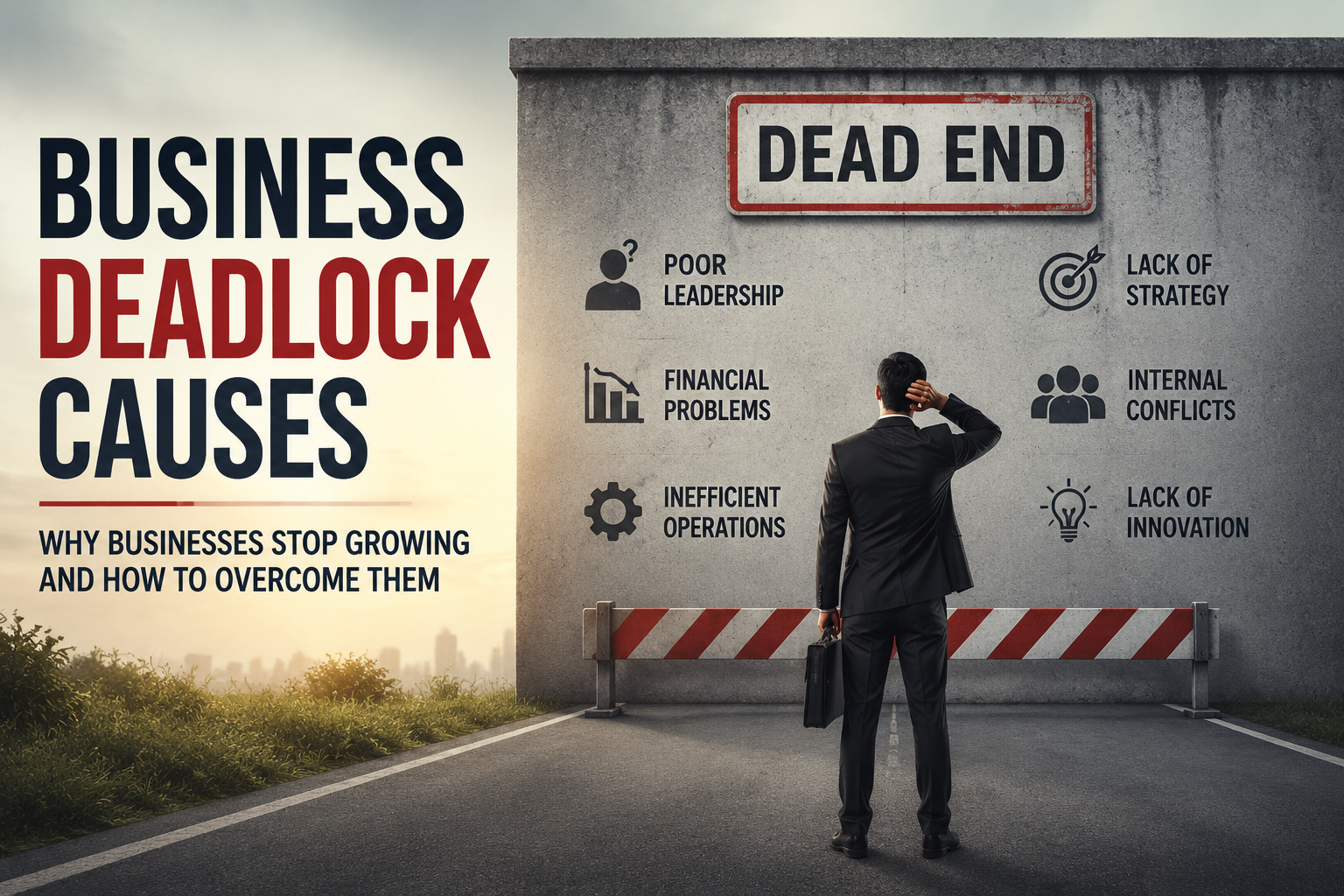





Every business starts with a goal: growth, profitability, and long-term success. Entrepreneurs invest time, money, and effort to build products, attract customers, and create sustainable operations. However, many businesses eventually reach a stage where progress slows down or completely stops. Sales become stagnant, decisions take longer, employees lose motivation, and new opportunities become difficult to achieve.
This situation is commonly known as a business deadlock.
A business deadlock does not always mean that a company is failing. Instead, it represents a condition where a business becomes unable to move forward because of internal challenges, poor strategic decisions, financial limitations, operational weaknesses, or external market pressures.
Understanding the major business deadlock causes is important because early identification allows business owners and managers to take corrective action before small problems become serious threats to the company’s future.
What Is a Business Deadlock?
A business deadlock occurs when an organization reaches a point where progress becomes difficult because important areas of the business are blocked. The company may continue operating, but growth opportunities are limited and improvements become harder to achieve.
For example, a company may have talented employees and quality products but still experience stagnation because leadership cannot agree on future direction. Another business may have strong customer demand but struggle because poor financial management prevents expansion.
A deadlock can happen at different levels of a business, including leadership, operations, finance, marketing, customer relationships, and organizational culture.
Unlike temporary business challenges, a deadlock often continues because the underlying problems are not properly identified or solved.
1. Poor Leadership and Ineffective Decision-Making
One of the most common causes of business deadlock is weak leadership. Every successful organization requires leaders who can create a clear vision, make timely decisions, and guide teams through difficult situations.
When leadership becomes ineffective, businesses often lose direction. Managers may spend too much time discussing problems without taking action, or different leaders may have conflicting opinions about the future of the company.
Slow decision-making can also prevent businesses from responding quickly to competitors, changing customer expectations, or new market opportunities. In fast-moving industries, delayed decisions can create significant disadvantages.
Strong leadership does not mean making perfect decisions every time. It means having a clear process for evaluating situations, taking calculated risks, and moving forward when action is required.
2. Lack of a Clear Business Strategy
A business without a clear strategy often struggles to achieve consistent growth. Many companies become trapped because they focus only on daily operations while ignoring long-term planning.
A strong business strategy defines where the company wants to go and how it will get there. Without this direction, businesses may invest resources in the wrong areas, target the wrong customers, or create products that do not match market demand.
For example, a company may spend heavily on marketing campaigns without understanding its ideal customer profile. Although the company is active, its efforts may not produce meaningful results because there is no clear strategic foundation.
Successful businesses regularly review their strategies and adjust them based on customer needs, industry changes, and competitive conditions.
3. Internal Conflicts Between Owners, Managers, or Teams
Internal disagreements can create serious obstacles for business growth. This is especially common in companies with multiple founders, family ownership structures, or several decision-makers.
When people within an organization have different opinions about goals, investments, hiring decisions, or business direction, progress can slow dramatically.
For example, one partner may want to expand aggressively while another prefers maintaining the current business size. Without proper communication and conflict resolution, these disagreements can prevent important decisions from being made.
A healthy business environment requires transparency, clearly defined responsibilities, and effective communication between all stakeholders.
4. Financial Problems and Poor Cash Flow Management
Financial difficulties are another major reason businesses experience deadlock. Even profitable companies can struggle if they do not manage their cash flow properly.
Many businesses fail to grow because money is tied up in unnecessary expenses, unpaid invoices, excessive inventory, or poor investment decisions.
Cash flow problems can limit a company’s ability to:
- Hire skilled employees
- Improve products
- Invest in marketing
- Expand into new markets
- Adopt new technology
A business owner may have excellent ideas for growth, but without financial stability, implementing those ideas becomes difficult.
Regular financial analysis, proper budgeting, and careful investment planning are essential for avoiding financial deadlock.
5. Failure to Adapt to Market Changes
Markets are constantly changing. Customer expectations, technology, competition, and industry trends evolve over time. Businesses that fail to adapt often experience stagnation.
A company that was successful several years ago may struggle today if it continues using outdated methods.
For example, businesses that ignored digital transformation lost opportunities to competitors that adopted online platforms, automation, and modern customer engagement strategies.
Adaptability is one of the most important qualities of successful companies. Businesses must continuously monitor market trends and be willing to improve their products, services, and processes.
6. Losing Connection With Customers
Customers determine the success of every business. When companies stop understanding customer needs, they often experience declining growth.
A business may face customer-related deadlock when it assumes it already knows what customers want and stops collecting feedback.
Customer preferences change over time. New competitors may offer better experiences, lower prices, or more convenient solutions.
Businesses that regularly communicate with customers, analyze feedback, and improve their offerings are better positioned to maintain growth.
7. Inefficient Business Operations
Operational inefficiency can quietly slow down a company’s progress. Even businesses with strong products and talented employees can struggle if their internal processes are poorly designed.
Common operational problems include outdated systems, unnecessary manual tasks, poor communication between departments, and inefficient workflows.
As a business grows, it needs stronger systems and processes. Without proper operational management, growth can create more problems instead of more opportunities.
Improving automation, documentation, and workflow management can help businesses remove operational barriers and increase productivity.
8. Lack of Innovation and Continuous Improvement
Innovation is necessary for long-term survival. Businesses that stop improving often lose their competitive advantage.
Innovation does not always mean creating completely new products. It can also involve improving customer service, adopting better technology, optimizing processes, or finding more efficient ways to operate.
Companies that become comfortable with their current success may ignore warning signs until competitors gain a stronger position.
A culture of continuous improvement helps businesses remain flexible and competitive.
9. Weak Marketing and Brand Positioning
A business can have excellent products but still struggle if customers do not understand its value.
Poor marketing creates a disconnect between the company and its target audience. Customers may not know why they should choose one business over another.
Weak brand positioning, unclear messaging, and ineffective marketing channels can limit customer acquisition and slow growth.
A successful marketing strategy focuses on understanding customer problems and communicating how the business provides solutions.
10. Resistance to Change
One of the biggest obstacles to business growth is refusing to change.
Some business owners continue using traditional methods because those approaches worked in the past. However, previous success does not guarantee future success.
Technology, customer behavior, and competition continue evolving. Businesses that refuse to adapt may eventually lose their market position.
Successful companies understand that change is not a threat; it is an opportunity to improve and grow.
How Can Businesses Overcome Deadlock?
Breaking a business deadlock requires identifying the real cause behind stagnation. The solution is different for every company because each business faces unique challenges.
The first step is conducting an honest evaluation of the company’s current situation. Leaders should analyze financial performance, customer feedback, operational efficiency, employee engagement, and market position.
Improving communication between leadership teams can remove decision-making barriers. Creating a clear strategy helps everyone understand the company’s direction and priorities.
Businesses should also focus on innovation, technology adoption, customer understanding, and financial discipline. Small improvements in these areas can create significant positive changes over time.
Final Thoughts
Business deadlock is a common challenge that affects companies of all sizes. It usually develops because of multiple factors, including weak leadership, unclear strategy, financial problems, operational inefficiency, and failure to adapt.
The most successful businesses are not those that never face challenges. They are the businesses that recognize problems early and take action to solve them.
By understanding the major business deadlock causes and implementing effective solutions, companies can overcome stagnation, restore growth, and build a stronger foundation for long-term success.
Frequently Asked Questions
What are the main causes of business deadlock?
The main causes of business deadlock include poor leadership, unclear strategy, financial difficulties, internal conflicts, operational problems, weak marketing, and failure to adapt to market changes.
Can a successful company experience business deadlock?
Yes. Even successful companies can experience deadlock when they stop innovating, fail to understand customers, or struggle with internal management issues.
How can a business recover from a deadlock situation?
A business can recover by reviewing its strategy, improving leadership communication, managing finances effectively, adopting innovation, and focusing on customer needs.